Start The Process
Submit your contact details & we'll reach out to you shortly.

For residential homeowners, a clogged gutter is an inconvenience. For property managers overseeing commercial buildings, apartment complexes, HOAs, or multi-unit properties, a neglected gutter system is a liability. Water damage from failed gutters doesn’t just affect one unit or one room — it can affect multiple tenants, multiple floors, and trigger insurance claims, tenant complaints, and repair bills that dwarf the cost of routine maintenance many times over.
Western Massachusetts adds its own layer of complexity. The Pioneer Valley sees heavy leaf fall from a dense mix of oak, maple, and birch trees, persistent pine needle accumulation throughout the year, and a winter characterized by freeze-thaw cycles that are particularly hard on commercial gutter systems. Managing a property in this region without a scheduled gutter maintenance plan isn’t just an oversight — it’s a risk management gap.
This guide is written specifically for property managers in Western MA who are responsible for maintaining commercial buildings, multi-family properties, apartment complexes, or HOA communities. Here’s what you need to know.
The basic principle is the same — keep gutters clear so water drains away from the building. But commercial gutter maintenance differs from residential in several important ways that affect how often you need service, what type of system you need, and what the consequences of neglect look like.
Scale. Commercial and multi-unit properties have significantly more linear footage of gutters than a single-family home. More footage means more debris accumulation, more downspouts to maintain, and more surface area where problems can develop. A single missed cleaning that might cause minor overflow on a residential home can cause widespread water intrusion across multiple units on a larger property.
Roof type and drainage volume. Commercial buildings often have flat or low-pitch roofs that collect more standing water and debris than pitched residential roofs. Larger roof surface areas also mean higher volumes of water moving through the gutter system during a rainstorm — which requires properly sized gutters and downspouts to handle the load. Most commercial properties in Western MA require 6-inch gutters with larger downspouts rather than the 5-inch systems standard on residential homes.
Tenant and liability exposure. On a residential property the owner bears the consequences of gutter neglect personally. On a commercial or multi-unit property, failed gutters can affect paying tenants, trigger lease disputes, generate liability claims from water damage to tenant property, and in some cases create health issues from mold resulting from water intrusion. The stakes are categorically higher.
Code and insurance considerations. Some commercial property insurance policies have maintenance requirements built in. Documented neglect of routine maintenance — including gutter cleaning — can complicate or invalidate claims related to water damage. Keeping a maintenance log that includes scheduled gutter cleanings is basic risk management for any commercial property.
For most commercial properties in Western Massachusetts, a minimum of three cleanings per year is the professional recommendation — more than the twice-yearly standard for residential homes. Here’s how that schedule typically breaks down:
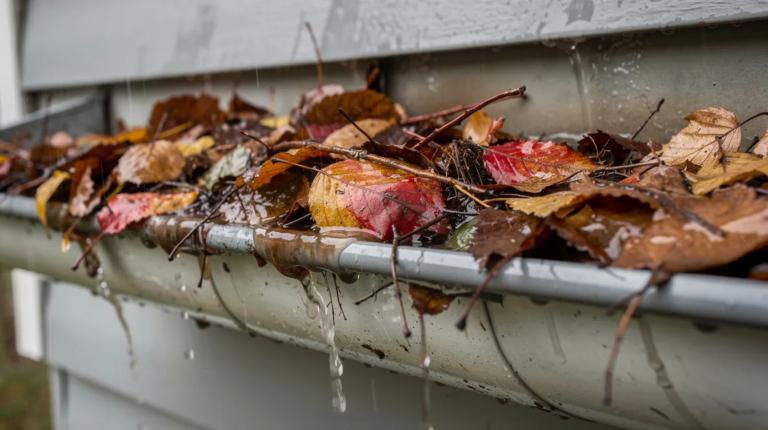
Late spring (April–May). Clears the winter accumulation — compacted leaf debris, shingle grit, seed pods from maple and cottonwood trees, and pine pollen buildup. This cleaning sets the system up to handle the heavy spring and summer rainfall season without overflow.
Early fall (September–October). A pre-leaf-drop cleaning that clears summer debris — storm damage, accumulated dirt, and any buildup from summer growth — before the heaviest leaf fall begins. For properties with heavy tree coverage this cleaning is particularly important.
Post-leaf-drop (November). The most critical cleaning of the year for Western MA properties. Done after the majority of leaves have fallen and before the first hard freeze, this cleaning is what prevents ice dam formation through the winter. Skipping this one is the single most common cause of winter water damage on commercial properties in the Pioneer Valley.
Properties that need more frequent service. If your property has heavy pine tree coverage, is surrounded by mature deciduous trees, or has had recurring overflow or ice dam issues, quarterly cleanings — or even monthly inspections during peak seasons — may be warranted. Properties with older gutter systems or known drainage issues should be on an accelerated schedule until those issues are addressed.
If you’re not sure what schedule makes sense for your specific property, our gutter cleaning and repair service includes an assessment of your system and a recommendation based on your building’s size, roof type, and surrounding environment.
Ice dams are a residential problem that property managers know well — but they’re a significantly larger issue on commercial and multi-unit properties. Here’s why.
On a single-family home, an ice dam typically affects one section of the roofline and potentially one interior space. On a three-decker, an apartment complex, or a commercial building, ice dams can form along the entire eave line and force water into multiple units simultaneously. The resulting damage — water-stained ceilings, soaked insulation, damaged drywall, potential mold — affects multiple tenants at once and generates multiple repair and remediation projects from a single weather event.
The mechanics are straightforward: clogged gutters going into winter prevent snowmelt from draining off the roof. Water backs up, freezes at the eave line, and the ice dam it creates forces water up under shingles and into the building. Western Massachusetts sees significant freeze-thaw cycling through January and February — temperatures that swing above and below freezing repeatedly, driving repeated cycles of snowmelt and refreezing that compound ice dam severity with every cycle.
The November post-leaf-drop cleaning is the primary defense. Clear gutters drain snowmelt properly and break the ice dam formation cycle before it starts. For properties that have had recurring ice dam issues, gutter guard installation is worth serious consideration — reducing debris accumulation through the fall means gutters stay cleaner longer and drain more effectively heading into winter.
A professional gutter maintenance visit on a commercial property should go beyond just clearing debris. For property managers, here’s what a thorough service visit should include and document:
Full debris removal. All leaves, twigs, pine needles, dirt, and sediment cleared from every gutter channel on the property. Not skimmed — fully cleared.
Downspout flushing. Every downspout flushed to confirm free drainage. Commercial properties often have downspouts that connect to underground drainage systems — these should be checked for blockage at the connection point as well as through the above-ground section.
Pitch and drainage check. Water should flow consistently toward downspouts with no pooling. After cleaning, a water test confirms proper drainage slope across every run. Any sections that have lost pitch should be flagged for rehinging.
Visual inspection of hangers and fasteners. Commercial buildings with long gutter runs put significant stress on hangers, particularly after winters with heavy snow and ice loads. Loose or pulled-out hangers should be identified and noted.
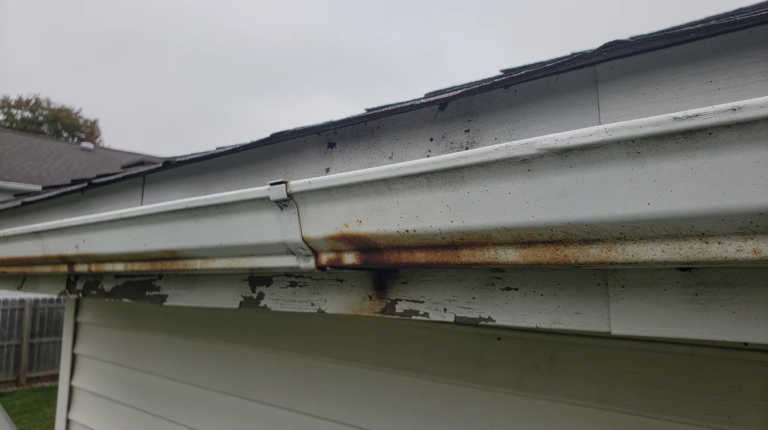
Seam and joint integrity. Leaking seams on older sectional systems should be identified and resealed. Persistent leaks at the same joint after repeated resealing are a signal that section replacement or a full system upgrade may be more cost-effective than ongoing repairs.
Fascia condition check. The condition of fascia boards behind the gutters should be noted during every visit. Early-stage moisture damage to fascia is repairable — advanced rot is a much larger project. Catching it early matters.
Downspout discharge check. Downspout extensions and splash blocks should be directing water a minimum of four to six feet away from the building foundation. On commercial properties, improper discharge that saturates soil along the foundation line is a common and preventable cause of foundation and basement water issues.
All of this should be documented. For property managers maintaining records for insurance purposes or owner reporting, a service visit that comes with a written summary of what was found and what was done is significantly more valuable than one that doesn’t.
Gutter guards aren’t just a residential upgrade — they make strong sense for commercial properties where the cost of frequent professional cleanings across large linear footage adds up quickly, and where the consequences of a missed cleaning are more severe than on a single-family home.
Quality micro-mesh gutter guards reduce how often full cleanings are needed, keep debris out of downspouts, and help maintain consistent drainage through the fall and into winter. For a commercial property with significant tree coverage, the reduction in cleaning frequency and the improvement in winter drainage performance can justify the installation cost relatively quickly.
Guards work best when installed on a clean, properly functioning gutter system. If your current system has pitch issues, damaged sections, or aging hangers that need attention, those should be addressed before guards go on. Learn more about the gutter guard options we install for commercial and residential properties.
Many commercial properties in Western Massachusetts are running on older sectional gutter systems that are well past their useful life. Sectional systems — the kind pieced together from pre-cut lengths with sealant at every joint — have a practical lifespan of 10 to 15 years. After that, joints fail regularly, sections sag, and the system requires constant maintenance just to function at a basic level.
If your property’s gutter system is showing persistent leaks at seams, widespread sagging, sections that keep pulling away from the fascia, or gutters that overflow even right after cleaning, the ongoing repair and maintenance cost may already exceed what a full replacement would run. Seamless aluminum gutters — custom fabricated on-site to fit your building’s exact measurements — eliminate the joint failures that cause most commercial gutter problems and carry a significantly longer useful life than sectional systems. Our commercial gutter installation service covers properties of all sizes across Western Massachusetts and Connecticut.
For property managers overseeing multiple buildings, the most efficient approach is a scheduled maintenance agreement rather than reactive service calls. Here’s what a basic commercial gutter maintenance plan looks like in practice:
A scheduled agreement locks in your three annual cleaning dates — spring, early fall, and post-leaf-drop November — across all properties in your portfolio. Each visit includes full cleaning, downspout flushing, and a written inspection report. Any issues identified during a cleaning visit are flagged immediately with a repair recommendation and estimate, so nothing falls through the cracks between service dates.
This approach removes gutter maintenance from the reactive maintenance queue entirely. You’re not responding to a tenant complaint about water coming in — you’re preventing the conditions that cause that complaint in the first place.
Custom Gutters MA is a family-owned business with over 20 years of experience serving both residential and commercial properties across Western Massachusetts and Connecticut. We work directly with property managers and building owners on scheduled maintenance programs, repairs, guard installation, and full gutter replacement for properties of all sizes.
We offer free estimates on all commercial work and respond within 24 hours. Whether you manage a single multi-family building or a portfolio of commercial properties, we’re equipped to handle the scope and keep your systems performing year-round.
Contact us today to discuss a maintenance plan for your property.
How often should commercial gutters be cleaned in Massachusetts? A minimum of three times per year for most Western MA commercial properties — late spring, early fall, and post-leaf-drop in November. Properties with heavy tree coverage or recurring drainage issues may need quarterly service.
Do commercial properties need larger gutters than residential homes? Yes. Most commercial buildings and multi-unit properties require 6-inch gutters with larger downspouts to handle the higher drainage volume from larger roof surface areas. Some industrial buildings require 7-inch box gutters. Our team assesses every property and recommends the right system for the roof size and drainage needs.
Can you service multiple properties under one maintenance agreement? Yes. We work with property managers overseeing multiple buildings and can schedule maintenance across an entire portfolio on a coordinated schedule. Contact us to discuss what that looks like for your specific situation.
What’s the liability risk of neglecting commercial gutter maintenance? Significant. Water damage from clogged gutters on a commercial property can affect multiple tenants simultaneously, generate insurance claims, and in cases of documented maintenance neglect, complicate those claims. A documented maintenance schedule is basic risk management for any commercial property manager.
Do gutter guards work on commercial buildings? Yes — quality micro-mesh guards work well on commercial gutter systems and are particularly cost-effective on larger properties where the reduction in cleaning frequency has a meaningful impact on annual maintenance costs. Learn more about our gutter guard installation service.