Start The Process
Submit your contact details & we'll reach out to you shortly.


When Massachusetts homeowners start getting quotes for new gutters, the question almost always comes up: is it worth paying more for seamless gutters, or does the cheaper sectional option get the job done just as well? It’s a fair question — and the honest answer requires looking past the installation invoice to the full financial picture over the life of your home.
This guide focuses specifically on the return on investment side of that decision — what seamless gutters actually cost you over time versus what they save you, and why that math looks the way it does in a Western Massachusetts climate. If you want to understand the functional benefits of seamless systems, we’ve covered those in depth in our post on the long-term benefits of seamless gutters. What follows is the financial case.
Seamless gutters cost roughly 20 to 30 percent more than sectional systems at installation. In practical terms, for a standard two-story colonial in Western Massachusetts needing around 200 linear feet of gutters, you’re typically looking at a difference of $400 to $800 between a sectional quote and a seamless quote. On a project that runs $2,000 to $3,500 for seamless aluminum, that premium represents a meaningful but not dramatic difference in upfront spend.
The mistake most homeowners make is treating that $400 to $800 gap as the total cost comparison. It isn’t. It’s the starting point. The full comparison plays out over 10, 20, and 30 years — and that’s where seamless gutters make their case most clearly.
Seamless aluminum gutters have a service life of 20 to 30 years when properly maintained. Sectional aluminum gutters, by contrast, typically last 15 to 20 years — and that’s under favorable conditions. The reason is straightforward: every joint in a sectional system is a point of stress, corrosion, and eventual failure. A typical 200-linear-foot sectional installation has 15 to 20 or more joints. A seamless system covering the same home has 4 to 6 joints, located only at corners and downspout connections.
In a Pioneer Valley winter — where temperatures cycle above and below freezing dozens of times between November and March — that difference is amplified. Every freeze-thaw cycle puts stress on sealant and metal connections. Sectional joints that might last 10 years in a mild climate fail faster here.
Over a 30-year period, a homeowner with sectional gutters in Western Massachusetts is likely replacing the system at least once, and possibly managing repeated repairs in the years leading up to replacement. A homeowner with seamless gutters installed properly is likely still running the original system at year 25. That one replacement cycle alone — typically $1,500 to $3,000 for a sectional system — erases the upfront premium on seamless gutters many times over.
The financial case for seamless gutters isn’t just about avoiding replacement — it’s about avoiding what happens when gutters leak. This is where the ROI math gets significant.
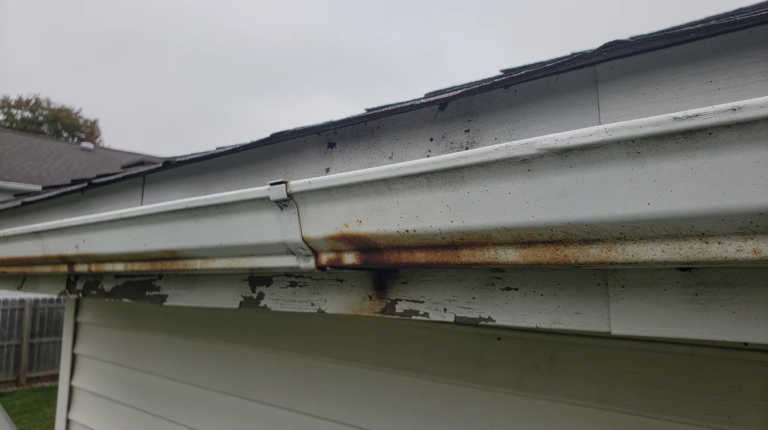
A seam failure in a sectional gutter system doesn’t announce itself. Water drips behind the fascia board quietly, often for months, before the damage becomes visible. By the time a homeowner notices a water stain on a ceiling or rot on a soffit, the repair bill is already substantial. Fascia board replacement on a typical Western MA home runs $1,000 to $3,000 depending on how much has rotted and whether the soffit is involved. Foundation waterproofing, triggered by water that pools at the base of the house from a failing gutter, can run $5,000 to $15,000 or more. Basement remediation for mold caused by persistent water intrusion is in the same range and carries health implications beyond the financial ones.
None of these are hypothetical scenarios. They are the predictable downstream consequences of gutter systems that leak at their joints — which is what sectional gutters do as they age, particularly in climates that stress their connections the way Western Massachusetts does.
Seamless gutters don’t eliminate leak risk entirely. Corners and downspout connections can still fail over time, particularly without maintenance. But with 80 to 90 percent fewer joints than a sectional system, the probability of a seam failure driving water damage into your home is dramatically lower across the life of the system.
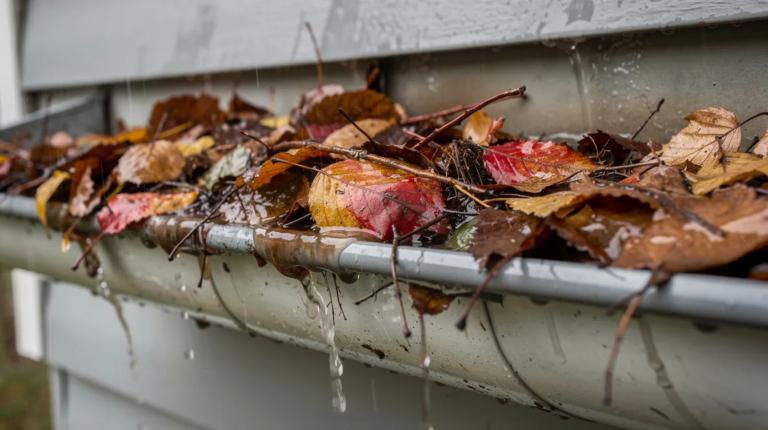
Beyond the damage prevention calculation, there’s a more routine financial advantage to seamless gutters: lower maintenance frequency. Sectional gutters snag debris at every joint and screw head inside the channel. Leaves, pine needles, and shingle grit catch on these protrusions and build up faster than they do in the smooth, uninterrupted channel of a seamless system.
For most Massachusetts homeowners, this means sectional gutters need professional cleaning more often — in some cases three times per year rather than twice — to prevent the overflow and ice dam conditions that result from blocked drainage. At $150 to $300 per professional cleaning, one additional cleaning per year adds up to $3,000 to $6,000 over 20 years. That’s a real cost, and it’s a cost that seamless gutter owners are less likely to incur at the same frequency.
Adding gutter guards to a seamless system at installation pushes this advantage further. Guards installed on a seamless system — where they sit flush against a smooth, uninterrupted channel — perform better and require less maintenance than guards retrofitted onto sectional systems. For homeowners surrounded by the oak, maple, and birch tree coverage common across Hampden and Hampshire County, the combination of seamless gutters and quality guards meaningfully reduces annual maintenance cost and effort over the life of the system.
The ROI case for seamless gutters isn’t limited to what you avoid spending — it includes what happens when you sell your home. Gutters aren’t a glamorous upgrade, but failing drainage systems show up on home inspections and generate negotiating leverage for buyers. Fascia rot, water stains on siding, and evidence of foundation moisture are among the most common issues inspectors flag, and all of them trace back, in many cases, to gutter systems that have been leaking.
A home with a properly functioning seamless gutter system — particularly one with documented installation age and a remaining manufacturer warranty — presents better in inspection than one with aging sectional gutters showing joint failures. The difference may not show up as a line item in the appraisal, but it shows up in how smoothly the sale closes and whether buyers have grounds to negotiate a price reduction for deferred maintenance.
For homeowners planning to stay in their home for five or more years, the ROI on seamless gutters is clear. For homeowners who may sell in the next two to three years, the calculus is tighter — but the inspection risk of deteriorating sectional gutters is a real factor worth weighing.
To make the comparison concrete, here’s how the costs stack up for a typical two-story colonial in the West Springfield area with approximately 200 linear feet of gutters over a 20-year period.
Sectional aluminum gutters installed: $1,500 to $2,200. Joint resealing at years 5 and 10: $400 to $800. One section replacement over 20 years: $300 to $600. One additional cleaning per year versus seamless: $3,000 to $6,000. Probability-weighted fascia or water damage repair: $1,000 to $5,000. Total 20-year cost range: $7,200 to $14,600.
Seamless aluminum gutters installed: $2,000 to $3,500. Standard bi-annual cleaning over 20 years: $6,000 to $12,000. Minor corner or downspout repair over 20 years: $150 to $500. Total 20-year cost range: $8,150 to $16,000.
The ranges overlap — which is honest. For a homeowner who is meticulous about maintaining a sectional system and happens to avoid any significant water damage events, the 20-year cost difference is modest. But the sectional scenario depends on things going right. The seamless scenario is structurally more likely to go right, because the system has far fewer points of failure built into it from day one.
What this comparison also doesn’t capture is the variance risk. The $1,000 to $5,000 damage repair estimate in the sectional column is a probability-weighted average — individual homeowners who experience foundation water intrusion or significant fascia rot will see numbers at the high end of that range or above it. The seamless scenario carries substantially less of that tail risk.
For most Massachusetts homeowners planning to stay in their home for five or more years, seamless aluminum gutters are worth the investment. The upfront premium over sectional gutters is real but modest. The savings over time — through reduced maintenance frequency, avoided seam failures, lower probability of consequential water damage, and a longer replacement cycle — more than justify the difference in the vast majority of cases.
The one scenario where sectional gutters make straightforward financial sense is a short time horizon — a homeowner who is selling within two or three years and doesn’t want to invest in a full system. For everyone else, the math runs in favor of seamless.
If you’re ready to get a number specific to your home, Custom Gutters MA offers free estimates with no obligation — returned within 24 hours. We’ve been installing seamless aluminum gutters across Western Massachusetts for over 20 years, and we can tell you exactly what your roofline needs and what it will cost.
How much more do seamless gutters cost than sectional gutters?
Seamless gutters typically cost 20 to 30 percent more than sectional systems at installation — usually $400 to $800 more for a standard Western MA home. That upfront difference is generally recovered through lower maintenance costs, a longer replacement cycle, and reduced probability of water damage over the life of the system.
How long do seamless aluminum gutters last in Massachusetts?
Properly installed and maintained seamless aluminum gutters last 20 to 30 years. Sectional aluminum gutters in the same climate typically last 15 to 20 years, with joints that begin failing sooner due to the stress of Western Massachusetts freeze-thaw cycles.
Do seamless gutters require less maintenance?
Yes. With 80 to 90 percent fewer joints than sectional systems, seamless gutters accumulate debris more slowly and are less prone to clogs and seam failures. Most Massachusetts homeowners can maintain a seamless system with two professional cleanings per year rather than three, which adds up to meaningful savings over time. Adding gutter guards at installation reduces this further.
Do seamless gutters increase home value?
Seamless gutters don’t generate a specific appraised value increase the way a kitchen renovation might, but they present well during home inspections and reduce the probability of water damage findings that give buyers grounds to negotiate. For most Massachusetts homeowners, that translates to a smoother sale and less inspection-driven price pressure.
What happens if a seamless gutter is damaged?
If a section of seamless gutter is damaged — by a falling branch, for example — repair typically requires a professional with the right equipment to fabricate a matching replacement section. This is a meaningful difference from sectional systems where individual pieces can be swapped out at a hardware store. In practice, damage requiring a full run replacement is rare, and the repair cost ($150 to $500 for most situations) is far lower than the cumulative seam maintenance cost on a sectional system over the same period.