Start The Process
Submit your contact details & we'll reach out to you shortly.


Every Massachusetts homeowner faces this question eventually. Your gutters are leaking, sagging, or pulling away from the fascia, and you’re trying to figure out whether a repair will fix it or whether you’re throwing money at a system that needs to come down. The answer isn’t always obvious — and the wrong call in either direction costs you money.
This guide gives you a clear decision framework for making that call on your own home, with cost benchmarks specific to the Western Massachusetts market. If your gutters have been showing multiple warning signs and you’re not sure what you’re looking at, our post on the 8 signs you need new gutters covers the physical symptoms in detail. What follows here is the financial and structural logic for what to do once you’ve identified a problem.
In most parts of the country, a slow-failing gutter system is an inconvenience. In Western Massachusetts, it’s a liability. Pioneer Valley winters cycle above and below freezing dozens of times between November and March. Every freeze-thaw cycle puts additional stress on any weakness in a gutter system — a failing seam that drips in October becomes a source of ice dam formation by January. A section that’s pulling slightly away from the fascia in September can be fully detached after the first heavy snow load.
This climate reality means that minor gutter problems escalate faster here than they would in milder regions, and the window between “repairable” and “needs full replacement” closes sooner. Understanding where your system sits on that spectrum before winter is one of the most valuable things a Massachusetts homeowner can do.
Before calling anyone for a quote, work through these four questions. They won’t replace a professional inspection, but they’ll give you a clear sense of where the conversation is likely to go.
The first question is how old is the system. Sectional aluminum gutters have a realistic lifespan of 15 to 20 years in a Western Massachusetts climate. Seamless aluminum systems last 20 to 30 years. If your gutters are approaching or past those thresholds, repair is often a short-term fix on a system that’s already in overall decline — you may patch one problem only to have another surface within a season or two. Age alone doesn’t mandate replacement, but it changes the math significantly.
The second question is how many problems exist simultaneously. A single leaking seam on an otherwise sound system is a repair. Multiple leaking seams, combined with sections that are sagging and a downspout that’s pulling away from the wall, is a replacement. When problems cluster, the system is failing systemically rather than at an isolated point, and repair costs start adding up toward or past the cost of a new installation.
The third question is whether the fascia is compromised. Gutter problems don’t stay contained to the gutter. Water that leaks behind a gutter channel drips onto the fascia board, and fascia rot is the most common secondary consequence of a neglected gutter system. If a professional finds soft or rotted fascia during a repair visit, that work has to happen before any repair or replacement is installed — and its cost needs to factor into which option you choose. Minor fascia damage is repairable for a few hundred dollars. Significant rot across multiple sections can run $1,000 to $3,000 and changes the economics of the decision entirely.
The fourth question is whether the current system is sectional or seamless. Sectional systems are easier to repair in isolation — individual sections can be replaced without touching the rest of the run. But they’re also more prone to recurring failures at joints, and each repair may only delay the next one by a few years. Seamless systems are more difficult to repair in isolation but are also less likely to develop the repeated seam failures that drive up sectional repair costs over time.
Understanding the cost of specific repair types gives you a baseline for evaluating quotes and comparing repair against replacement. These are current Massachusetts market ranges.
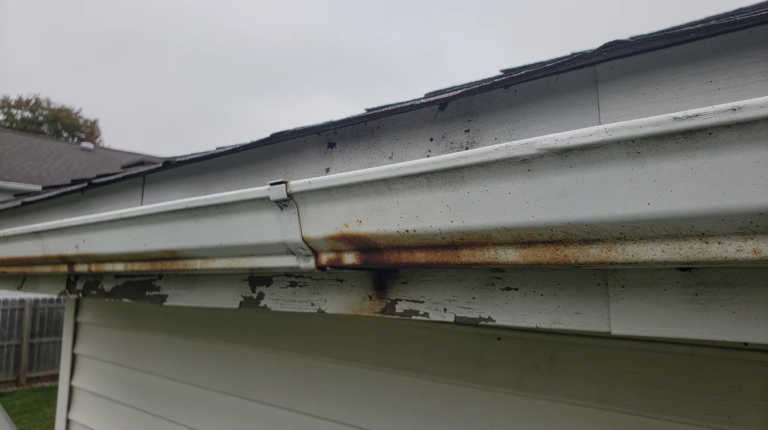
Resealing a leaking seam runs $100 to $300 per location. This is the most common repair on sectional systems and the most likely to recur. If you’re resealing the same seams repeatedly, that’s a signal the joint is failing structurally rather than just losing sealant.
Rehanging a sagging section — where hangers have pulled out of the fascia — runs $150 to $400 depending on how many brackets are involved and whether the fascia is solid enough to hold new fasteners. If the fascia is too deteriorated to hold a new hanger, fascia repair has to happen first.
Replacing a damaged section of sectional gutter runs $200 to $600 for a typical run, depending on length, profile size, and accessibility. On a seamless system, section replacement requires a professional with roll-forming equipment and typically runs $250 to $500 for a standard repair.
Downspout repair or replacement runs $8 to $15 per linear foot, with a single downspout replacement typically falling in the $75 to $200 range depending on height and routing complexity.
Fascia board replacement, when required alongside a gutter repair or replacement, typically runs $8 to $20 per linear foot for materials and labor — meaning a 20-foot affected section could add $160 to $400 to the job before the gutter work even starts.
A widely used rule of thumb in the gutter industry: if the cost of repairing your current system exceeds 50 percent of the cost of replacing it, replacement is almost always the better financial decision. Here’s why that threshold matters.
A repair that costs $600 on a system that could be fully replaced for $1,000 is a bad investment if the underlying system is aging and likely to generate another $400 in repairs within the next two years. You’ve spent $600 to extend the life of a system that’s still going to need replacement — and your total outlay becomes $1,600 instead of $1,000.
The 50 percent threshold isn’t a hard rule, but it’s a useful gut check. If a contractor quotes you repair costs that approach or exceed half the replacement cost on a system that’s already 15 or more years old, get a replacement quote alongside the repair quote before deciding.
For most Western MA homes, full seamless aluminum gutter replacement runs $2,000 to $3,500 for a standard two-story colonial. Using the 50 percent threshold, that means repairs approaching $1,000 to $1,750 on a system in overall decline warrant a serious replacement conversation. Our gutter cleaning and repair service includes an honest assessment of where your system sits — we’ll tell you what we find and let you decide.
Repair is the right answer in several clear scenarios. If your system is less than 10 years old and the problem is genuinely isolated — a single seam failure, one pulled hanger, a downspout that’s come loose from its bracket — repair is straightforward and cost-effective. A young, otherwise sound system has years of useful life remaining and doesn’t need to come down over a localized issue.
Repair also makes sense when the problem is a specific physical event — a branch fell on a section of gutter, or a ladder was placed incorrectly and dented a run. Isolated damage from a discrete cause is different from systemic aging failure, and a targeted repair resolves it cleanly.
Finally, repair is appropriate when a homeowner has a short time horizon and needs the system functional without a major capital outlay. If you’re selling your home within the next year and the gutters need to present reasonably well for inspection, targeted repairs may accomplish that goal more cost-effectively than a full replacement.
Replacement becomes the right call when the system is aging into overall failure rather than experiencing isolated problems. Multiple simultaneous issues — leaking seams in several locations, sections that are sagging, hangers that keep pulling out — indicate a system that’s past its useful life across its length, not just at one point.
Replacement is also the right call when the underlying fascia has deteriorated to the point where it can no longer support a repaired system reliably. Installing new gutters on compromised fascia just accelerates the next failure — the fascia work and the gutter replacement should happen together.
If your current system is sectional and approaching 15 years of age in a Western Massachusetts climate, a full replacement with seamless aluminum is worth serious consideration even if the immediate problems seem limited. The seamless system you install now will outperform a patched sectional system for the next 20 to 30 years and carry a manufacturer warranty that the repaired sectional system cannot.
The most reliable way to know whether your gutters need repair or replacement is a professional inspection by someone who isn’t going to upsell you either way. A reputable contractor will tell you honestly what they find — isolated problem that’s worth repairing, or systemic decline that points toward replacement — and give you a quote for both options so you can make an informed decision.
At Custom Gutters MA, we’ve been doing exactly that for over 20 years across West Springfield, Springfield, Agawam, Westfield, Chicopee, Holyoke, Longmeadow, East Longmeadow, Ludlow, and Southwick. Get a free estimate and we’ll tell you what we find — no pressure, no obligation, returned within 24 hours.
How do I know if my gutters need repair or replacement?
Start with age and scope. If your system is under 10 years old and the problem is isolated to one location, repair is usually the right call. If your system is 15 or more years old, has multiple simultaneous problems, or has compromised fascia behind it, replacement is likely the better long-term investment. A professional inspection will confirm which situation you’re in.
How much does gutter repair cost in Massachusetts?
Common gutter repairs in Massachusetts run $100 to $300 for seam resealing, $150 to $400 for rehanging sagging sections, and $200 to $600 for section replacement. Total repair costs for a system with multiple issues can reach $500 to $1,500 or more — at which point a full replacement quote is worth getting for comparison.
How much does full gutter replacement cost in Massachusetts?
For a standard two-story colonial in Western Massachusetts with approximately 200 linear feet of roofline, seamless aluminum gutter replacement typically runs $2,000 to $3,500, including materials, labor, downspouts, and hardware.
Can gutters be repaired instead of replaced?
Yes — in many cases repair is the right answer and a full replacement isn’t necessary. The decision depends on the age of the system, the number and nature of the problems, and the condition of the fascia behind the gutters. If repair costs approach 50 percent of replacement cost on an aging system, replacement usually becomes the better financial choice.
How long do repaired gutters last?
A good repair on a sound, relatively young system can extend gutter life by several years. A repair on an aging system that’s failing in multiple places typically buys one to three years before the next problem surfaces. If you find yourself repairing the same sections repeatedly, the system is telling you it needs replacement.
How often should I have my gutters inspected?
Professional gutter cleaning and inspection twice a year — late spring and late fall — catches developing problems before they become expensive ones. In a Western Massachusetts climate, the fall inspection before the first hard freeze is particularly important: catching a failing seam or a sagging section in October is far less costly than dealing with the ice dam consequences of that failure in February.